Ideas
May 2025







Type
IdeasArticle by
Domenic Cerantonio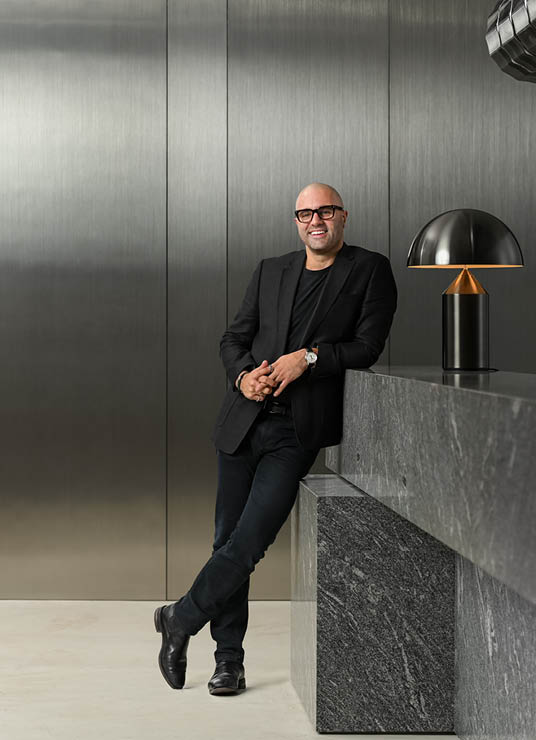
Architecture is not short on ideas, it is short on bandwidth.
Most practices are not constrained by imagination. They are constrained by the volume of work required to turn intent into reality, coordination, documentation, options analysis, compliance, client communication, consultant integration, and the thousand micro decisions that sit between concept and construction.
That is why AI matters; it attacks the constraint.
For years, the story of progress in architecture has been framed as better tools, faster delivery, more realism, more precision. Each wave of technology promised to free time for design, and in practice often did the opposite. The tools improved, but expectations expanded, deadlines tightened, deliverables multiplied, and the architect’s attention got dragged deeper into production.
AI feels like a different kind of shift. It does not just make drawing faster, it changes how thinking can be distributed. It creates the possibility that a portion of thinking work, not just drafting work, can be offloaded, accelerated, or run in parallel. That is why it feels unsettling, not because it threatens the profession’s existence, but because it challenges a habit we’ve built up over time, the idea that effort equals value, and hours equal legitimacy.
The real question is not whether AI can do architecture. It can’t. The real question is what happens when the cost of exploration, synthesis, and iteration collapses, and the bottleneck becomes judgment.
My view is simple, AI will not replace architects, but it will expose the difference between architects who lead and architects who produce.
At its best, the architect’s value has never been the ability to generate form on demand. It’s the ability to decide what is appropriate, what is coherent, what is worth building, what is defendable, what is ethical, what is beautiful, and what will still make sense in twenty years.
AI is powerful because it separates two things we’ve historically bundled together, creative exploration and manual labour. It can generate options, summarise constraints, draft communication, interrogate precedents, or pressure test a scheme against a brief, a planning framework, a cost plan, or an ESD target, in minutes. It can be a tireless second brain across the arc of a project.
But it does not know what matters.
It can produce outputs that look plausible, even impressive, without any stake in consequence. It can confidently recommend a direction that is wrong for the client, wrong for the site, wrong for the community, wrong for the budget, wrong for the climate, wrong for the culture. It is not accountable.
So the architect’s role becomes more explicit. Set intent. Define constraints with precision. Recognise quality. Make choices. Carry responsibility.
There is a bigger structural change hiding inside this too. Traditionally, creative power in architecture scaled with team size. If you wanted more exploration, you hired more people. If you wanted more output, you added headcount. If you wanted more capability, you built departments. That model creates leverage, but it also creates inertia, overhead, and sometimes a dilution of the original idea.
AI introduces a different kind of leverage. A small team with clear intent and good judgment can now explore more broadly and more quickly than a much larger team could, not because they are smarter, but because the friction of iteration collapses.
That can go two ways. One path is to use AI to increase volume, more images, more options, more decks, more noise. The other path is to use it to increase clarity, better decisions, better alignment, better outcomes. The future belongs to the second path.
Of course there are trade-offs, and it’s worth being honest about them.
AI makes it easy to mistake novelty for quality. It’s very good at producing things that look compelling, especially if you ask for bold, innovative outcomes. If you can’t explain why something is good, you are not really designing, you are selecting.
AI also makes it easy to confuse speed with resolution. You can move quickly, but coherence still takes time, not because it’s hard to generate options, but because it’s hard to choose a position and refine it. If AI increases the number of moves you can make in a day, you can end up making too many, and eroding the project’s core idea.
And AI speaks with confidence, especially when you are tired, rushed, or under pressure. The discipline is to treat it like a powerful junior team member, useful, fast, and sometimes wrong in subtle ways, then apply senior judgment.
The interesting thing is that if AI really does lift production work, it creates a vacuum. Someone has to fill that vacuum with leadership. That means architects need to get better at setting direction, defining success, making trade-offs explicit, and communicating intent to clients and consultants. If you don’t step into that space, AI won’t elevate your practice, it will just increase output.
The right posture is not fear, and it is not blind enthusiasm. It’s discipline.
Use AI aggressively, but do it in service of architectural responsibility, not in avoidance of it.
Because the uncomfortable truth is this, AI will make it obvious who has intent, and who has habit. Who can lead a project, and who can only execute tasks. Who understands quality, and who relies on process to produce something acceptable.
AI does not replace architectural intelligence, it amplifies it. Which means it also amplifies the consequences of weak judgment.
That is the frontier, not the technology itself, but the demand it places back on the architect to be clear, to be decisive, and to care.